CanvasComposer:
Personalized Group Photo Generation via a Multi-Reference Canvas
* Equal contribution

Existing personalized image generators still struggle to preserve multiple reference identities in natural and coherent multi-human generations. To address these limitations, we present CanvasComposer, an interactive framework for personalized group photo generation. Inspired by professional image-editing software, CanvasComposer allows users to place reference subjects on a shared canvas, where each subject keeps its own RGBA cutout of the input. This multi-reference canvas preserves reference content under overlap while providing an intuitive interface for organizing multiple identities; the subjects remain separate elements on the input canvas, and the model outputs a single personalized and harmonized image. To keep this representation efficient, transparent latent pruning retains only tokens from each subject's non-transparent region, and cross-reference training mitigates copy-paste artifacts by learning to harmonize references sampled from different images. Extensive experiments demonstrate that CanvasComposer achieves coherent generation and strong identity preservation compared to state-of-the-art methods in multi-human personalized image generation.
We propose an interactive personalization paradigm that allows users to place multi-human references in full-body, portrait, or cropped-head forms on a multi-reference canvas.
We introduce the multi-reference canvas, a simple and effective input representation that handles occlusions in multi-human personalization and improves efficiency through our transparent latent pruning strategy.
We present the subject-wise cross-reference training strategy, which effectively disentangles redundant visual information (e.g., poses) and mitigates copy-paste artifacts.
We develop CanvasComposer, a practical framework for interactive multi-human personalized generation. Extensive experiments demonstrate that CanvasComposer achieves state-of-the-art identity preservation and generation quality across multi-human personalization benchmarks.
Previous methods offer limited interactivity and scale poorly to multiple subjects. They rely on passive embedding injection, allow only text control, and suffer from linear growth of memory and computational cost as the number of subjects increases.
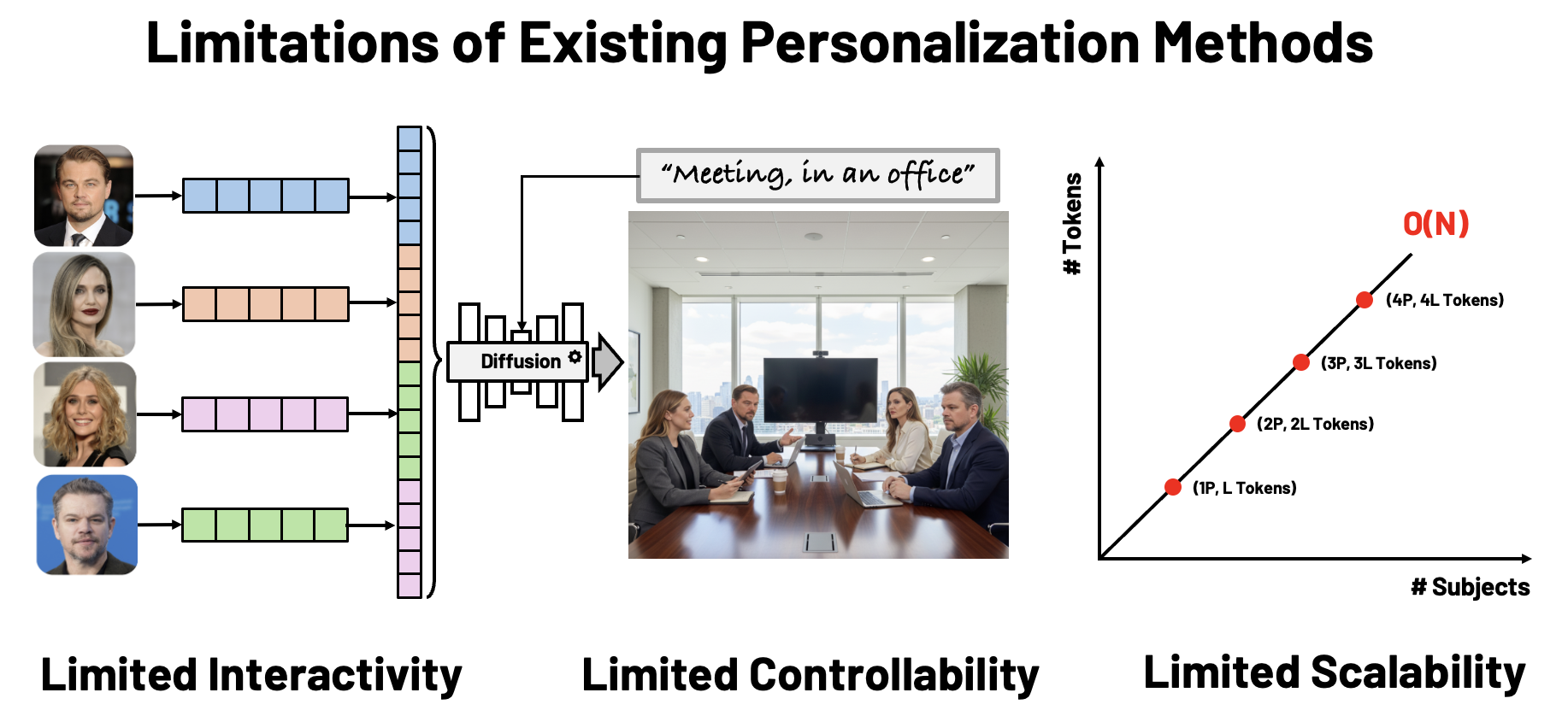
Whereas our approach introduces a multi-reference canvas that enables intuitive, direct-manipulation control over spatial composition and subject preservation.
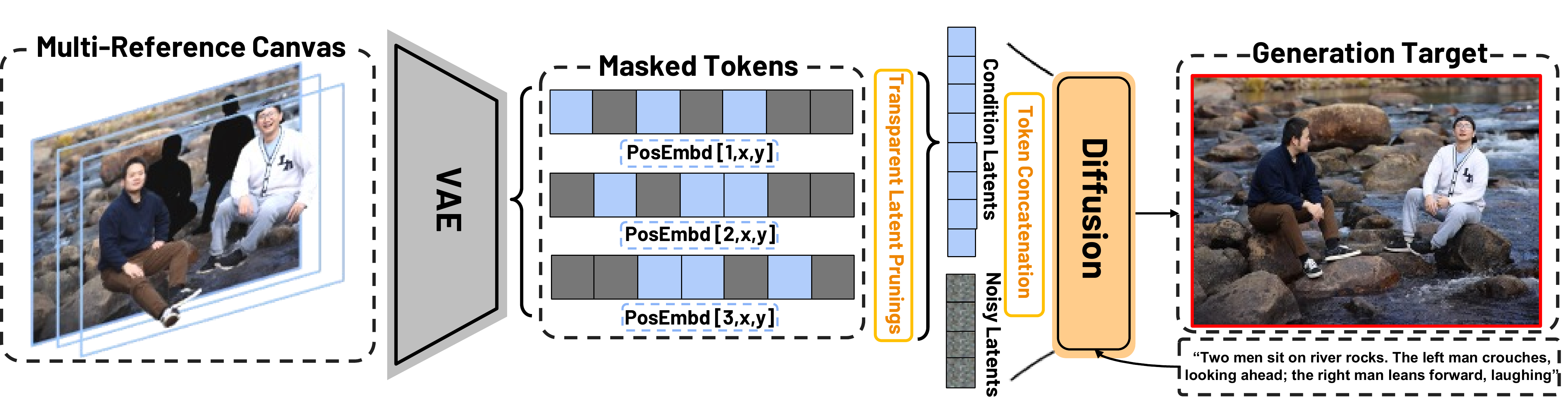
CanvasComposer conditions a pretrained diffusion model on a text prompt and a multi-reference canvas — a set of RGBA images L = {l₁, ⋯, l_N}, one per subject or optional background. The RGB channels provide visual reference for each element, while the alpha channel defines valid regions used to prune input tokens for efficiency. Subjects are placed separately with no fixed ordering; when a background is provided, regions it shares with foreground subjects are removed so the diffusion model can harmonize the final image with the text prompt.
CanvasComposer builds on a pretrained diffusion transformer (DiT), treating the multi-reference canvas as pruned in-context visual tokens and reusing the DiT's native self-attention and 3D RoPE interface for element-aware conditioning. Each element is VAE-encoded and assigned a positional embedding [j, x, y], where j separates canvas elements and (x, y) are spatial coordinates. Transparent latent pruning then keeps only tokens in non-transparent regions, discarding the rest — making conditioning length depend on content rather than subject count. The pruned latents are concatenated with the noisy image latents to form the DiT's input.
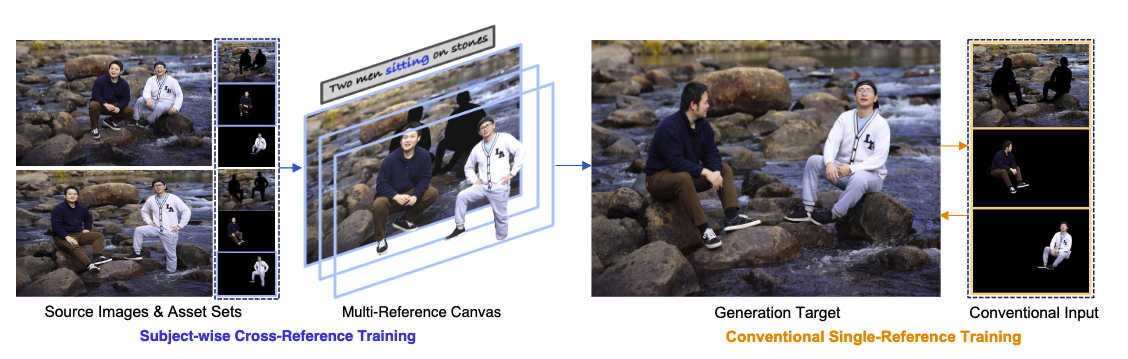
CanvasComposer employs a subject-wise cross-reference sampling strategy to mitigate copy-paste artifacts. We curate a multi-image-per-scene dataset where each scene contains several images of the same subjects under different poses and lighting. For each sample, one image is chosen as the target, while every subject's reference is sampled from a different image in the same scene and fit to the target's bounding box. This intentional mismatch encourages the model to disentangle pose and illumination rather than overfitting to pixel-level correspondences, as in conventional single-reference training.
While state-of-the-art baselines frequently distort, omit subjects, or produce unnatural copy-pasted artifacts, CanvasComposer consistently generates high-fidelity and coherent compositions, faithfully preserving identities and spatial arrangement of all subjects.
When personalizing an image with two subjects, competing methods often fail to compose a coherent, interactive scene. CanvasComposer produces visually coherent, high-fidelity scenes where both subjects are present and naturally interacting.
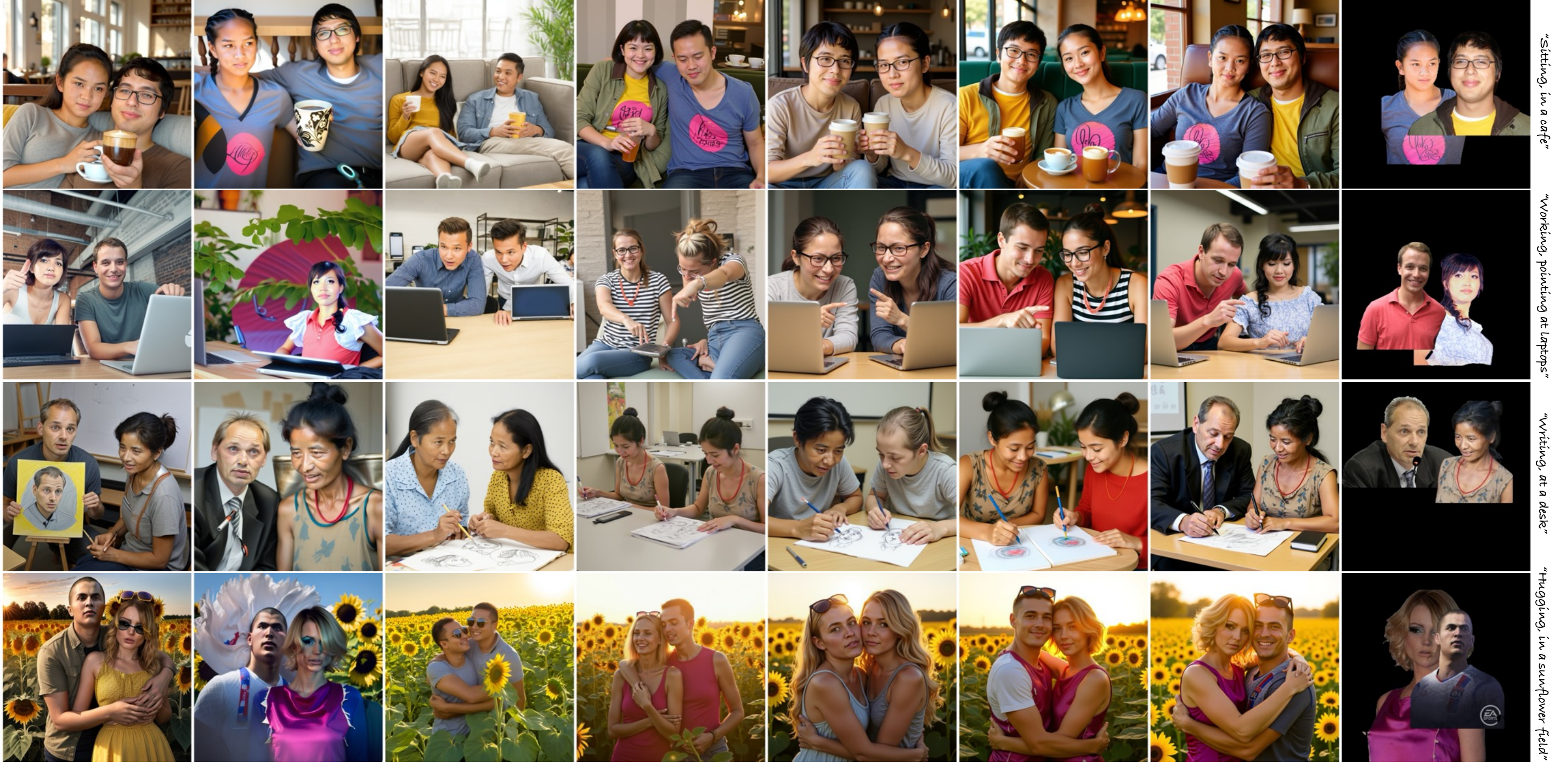
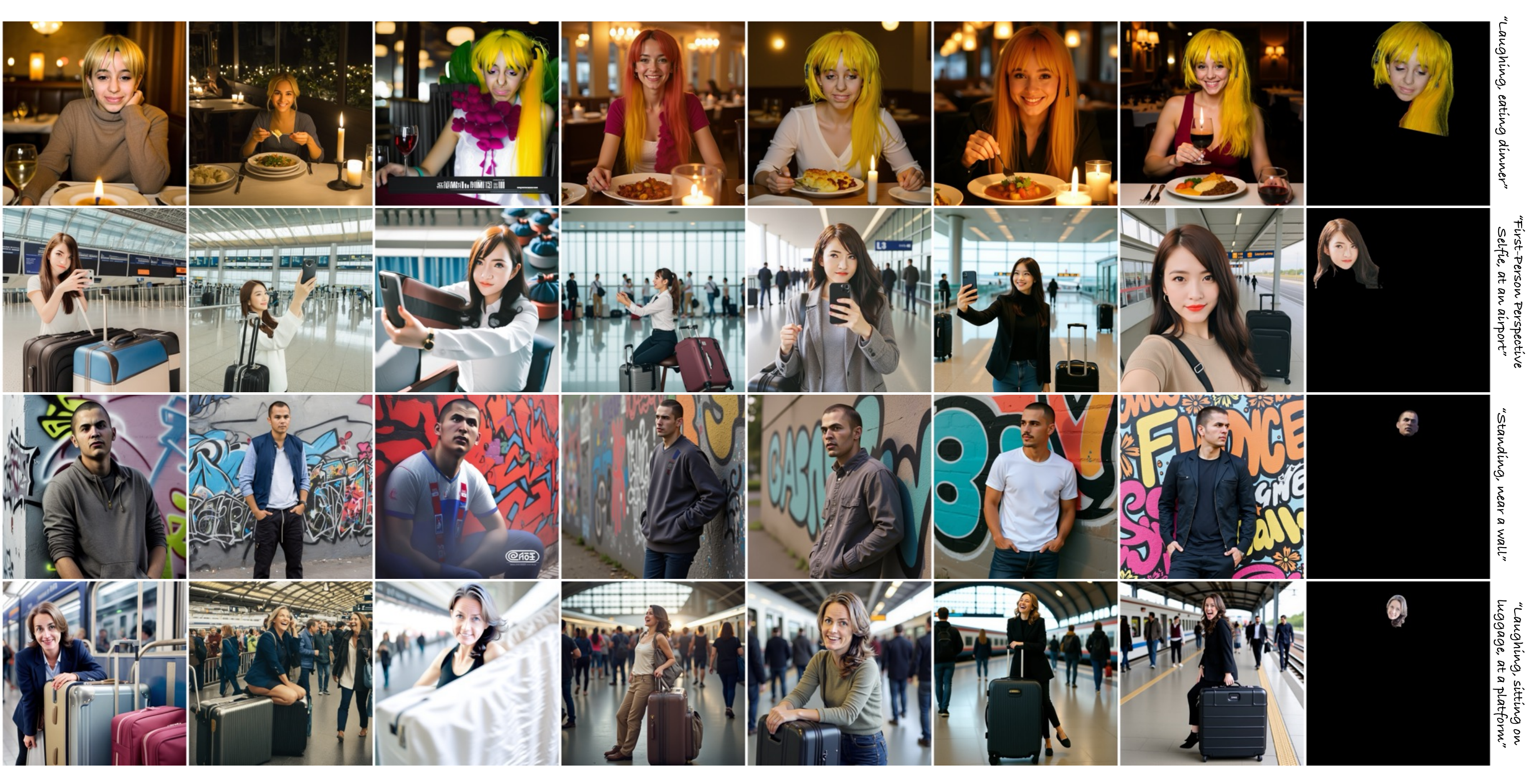
State-of-the-art 1P personalization approaches tend to inject the reference face identity with limited flexibility, resulting in copy-pasted effects. CanvasComposer generates realistic outputs, faithful to both the human identity and text prompt.
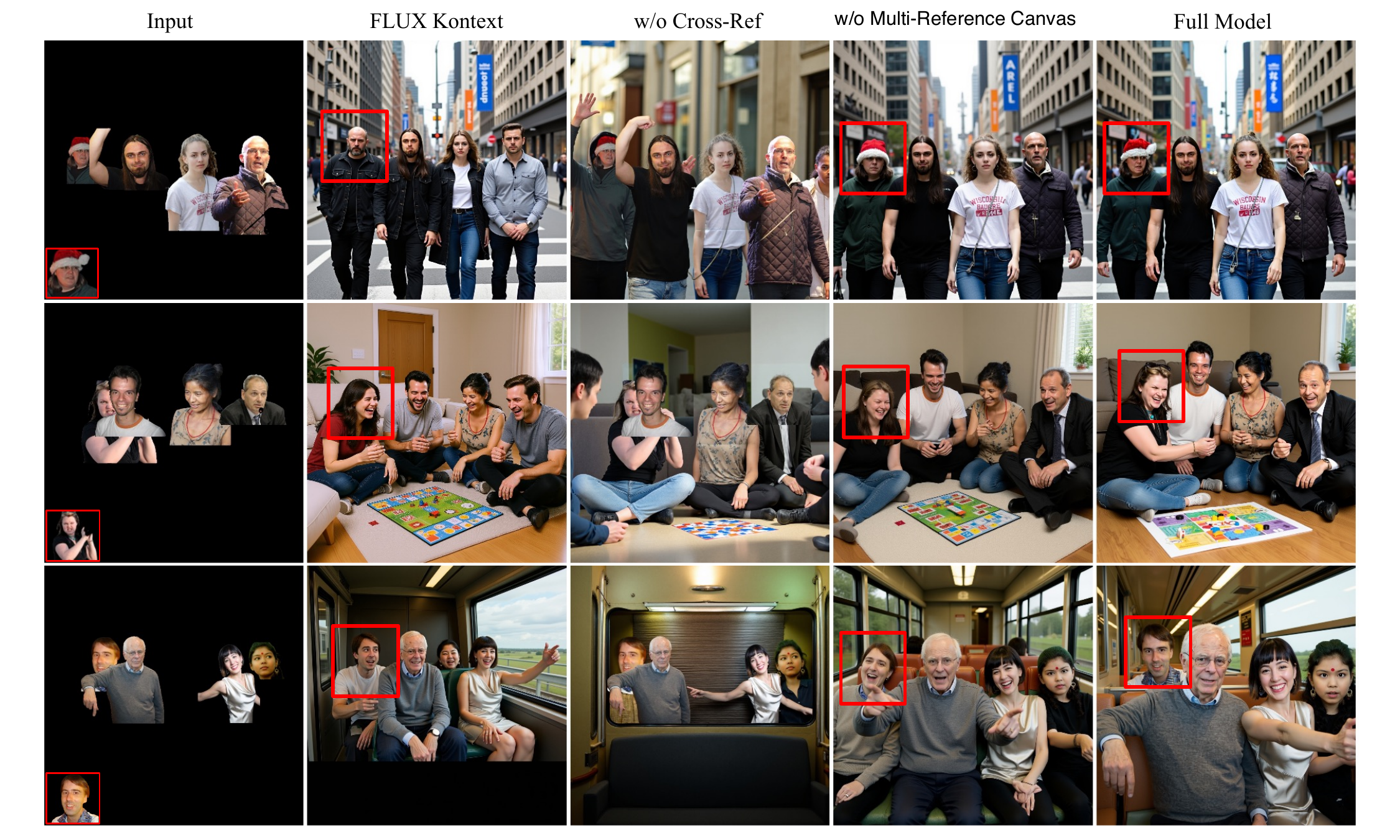
Removing subject-wise cross-reference training leads to copy-paste artifacts and degraded image quality, producing results that resemble naive outpainting rather than coherent multi-subject synthesis. In contrast, our full model preserves identities more naturally and avoids copying facial expressions from the inputs due to the disentanglement introduced by our training.
Without the multi-reference canvas, the model is trained on a single collage image ("Inputs" column). As subjects increase, occlusion becomes inevitable — e.g., the pom-pom on the red hat of the left woman is completely lost, and identity preservation degrades for the occluded person. CanvasComposer instead keeps each subject spatially independent, preserving each reference even under overlap.
On the 4P Personalization benchmark, transparent latent pruning reduces the average number of conditioning tokens from 16,384 to 2,200.2 (over 85% fewer) and lowers inference latency from 91.8s to 21.2s — 5,120 tokens and 44.3s without the multi-reference canvas, versus 16,384 tokens and 91.8s without transparent pruning at all.
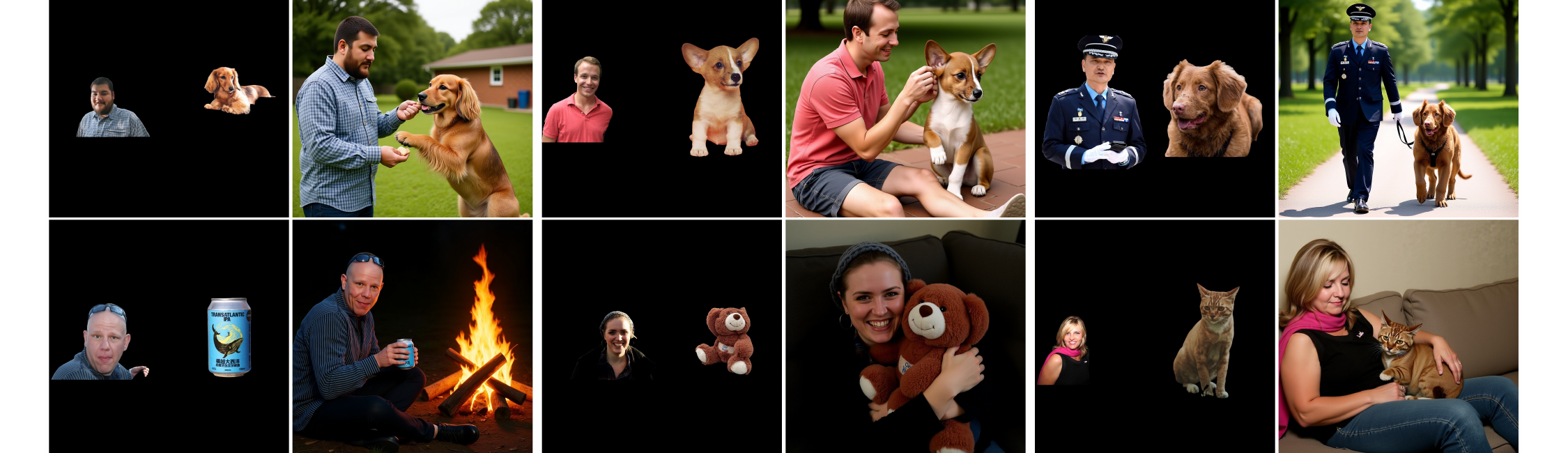
Beyond-Human Subjects. Although trained only on human-centric data, CanvasComposer can accept non-human objects placed on the canvas at inference and produce coherent interactions between people and surrounding objects.
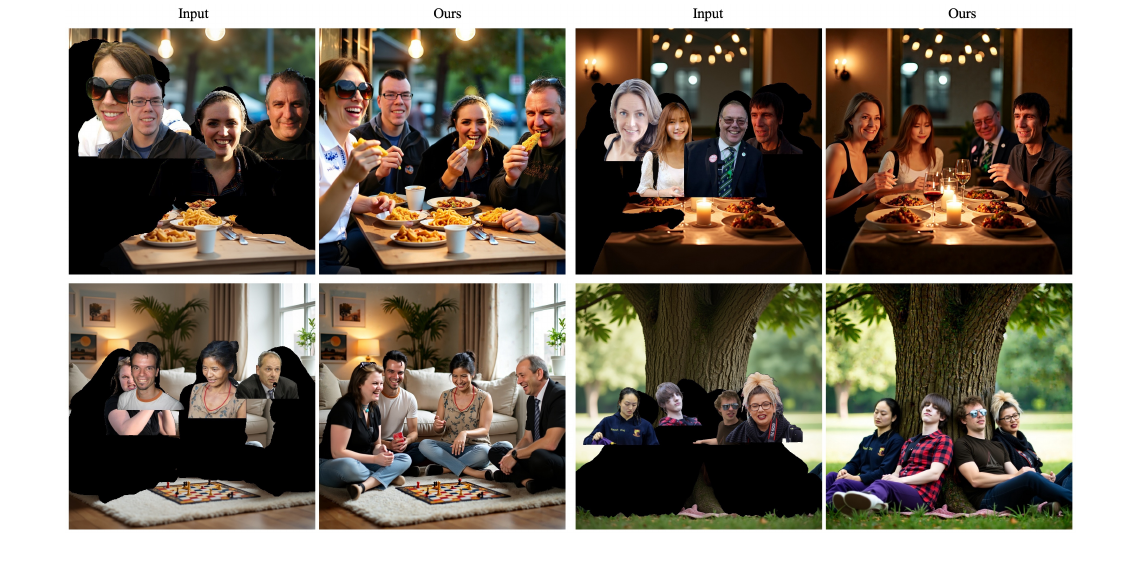
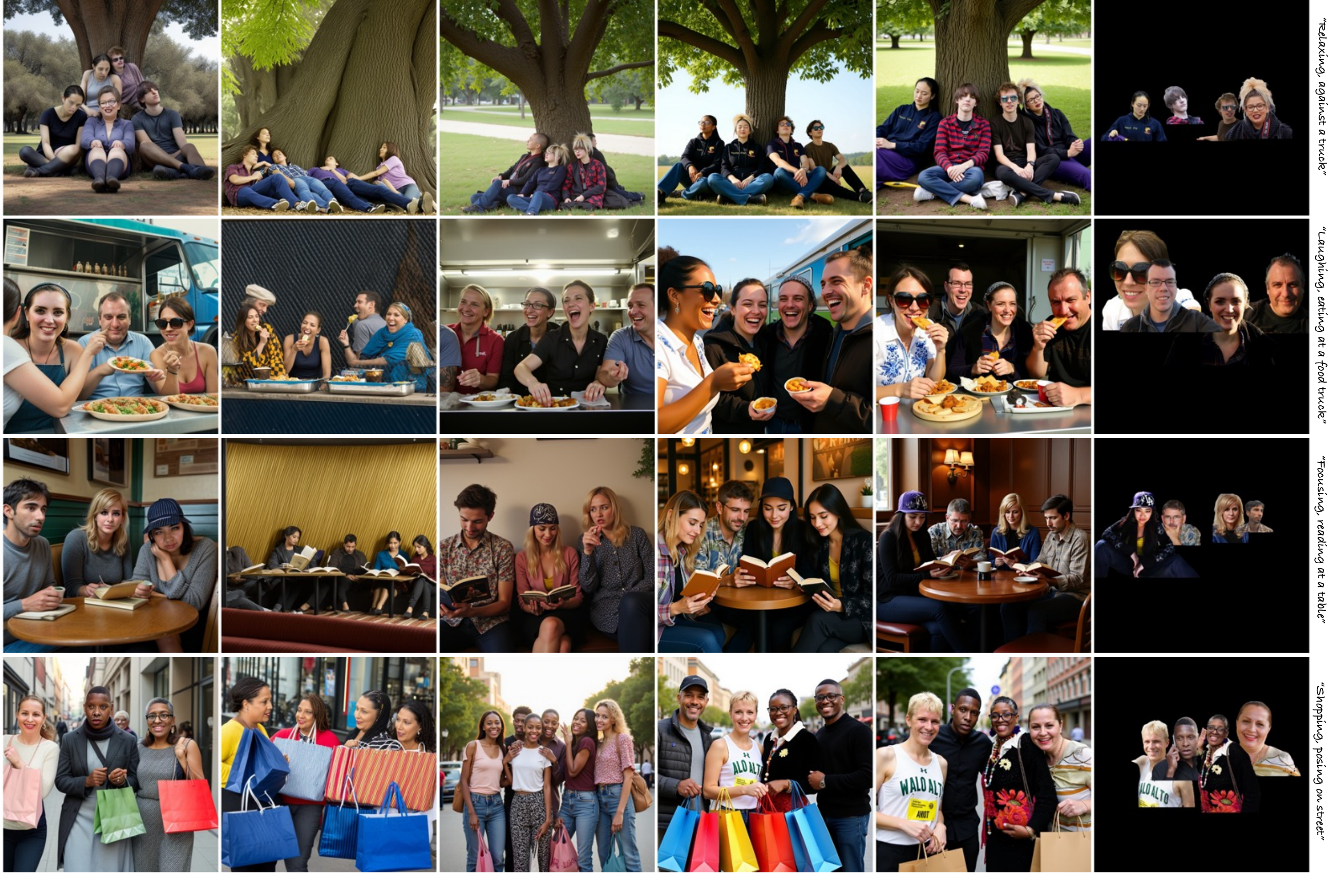
Personalization with Background. The multi-reference canvas can also accept an optional background image, resulting in five separate references (four people and one background); inserted humans interact naturally with the background, e.g. leaning against a tree trunk, under coherent lighting.
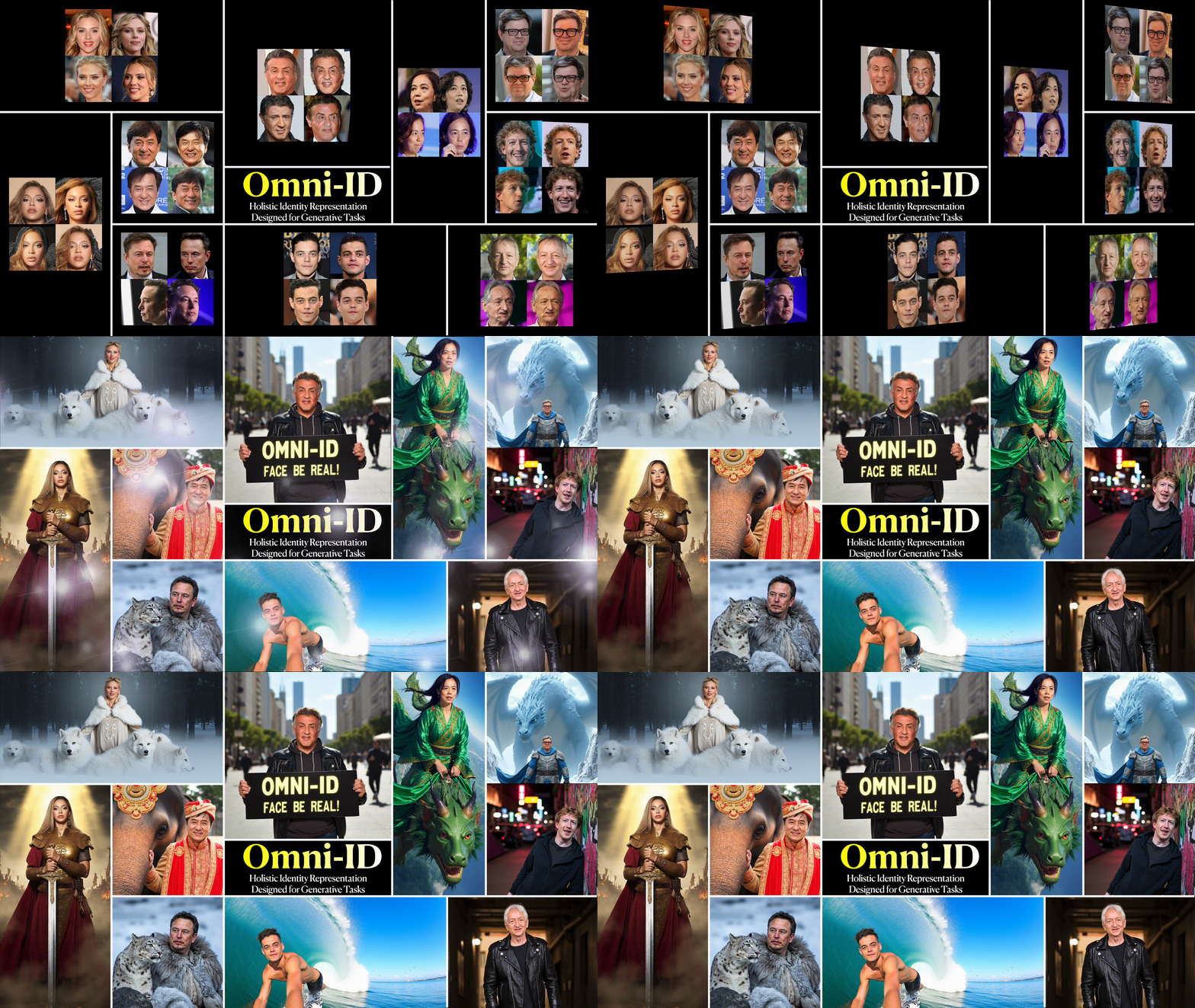
CVPR 2025
A novel facial representation designed specifically for generative tasks, encoding holistic information about an individual's appearance across diverse expressions and poses within a fixed-size representation.
Read Paper →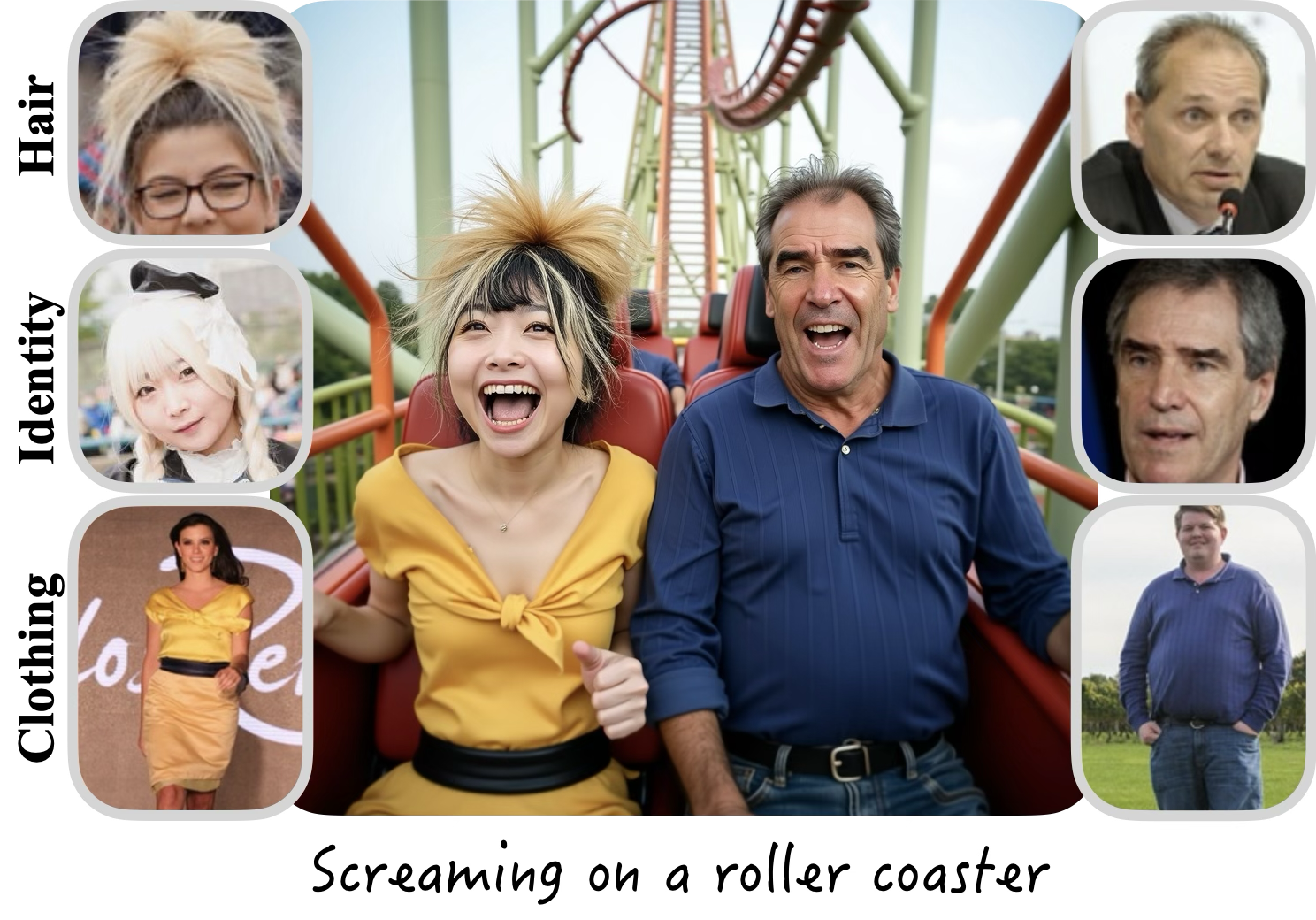
SIGGRAPH Asia 2025
A human-centric generative model that enables disentangled control over multiple visual attributes — such as identity, hair, and garment — across multiple subjects, while also supporting text-based control.
Read Paper →The authors would like to acknowledge Or Patashnik and Daniel Cohen-Or for their feedback on the paper; Maya Goldenberg for the demo video; the anonymous reviewers for their constructive comments; and other members of the Snap Creative Vision team for their valuable feedback and discussions throughout the project.
@inproceedings{qian2026canvascomposer,
  author    = {Gordon Guocheng Qian and Ruihang Zhang and Tsai-Shien Chen and Yusuf Dalva and Anujraaj Goyal and Willi Menapace and Ivan Skorokhodov and Meng Dong and Arpit Sahni and Daniil Ostashev and Ju Hu and Mukesh Singhal and Sergey Tulyakov and Kuan-Chieh Jackson Wang},
  title     = {CanvasComposer: Personalized Group Photo Generation via a Multi-Reference Canvas},
  booktitle = {SIGGRAPH Asia 2026 Conference Papers},
  year      = {2026},
}